
Engine Mounts, Couplings & Drive Plates
Everything between the engine and the shaft that keeps vibration out of the hull: Vetus flexible mounts from 15 to 500 kg per mount, Bullflex couplings to 2,200 Nm, and the damper plates that stop gearbox rattle — plus Australian-made Poly Flex systems.
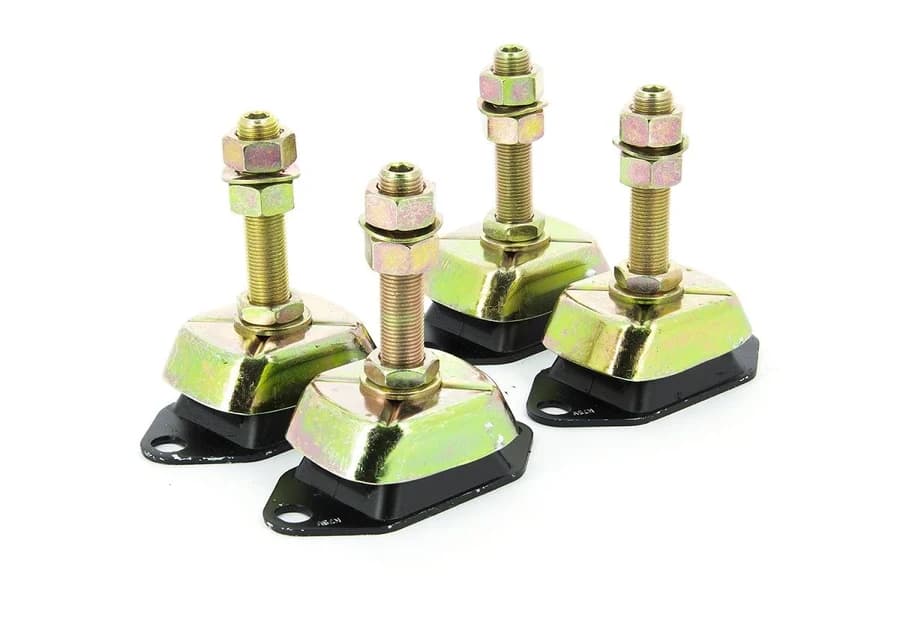
Three parts, one quiet driveline
Flexible mounts only work as part of a system — each piece covers for the movement the others allow.
Flexible mounts
Carry the engine and swallow its vibration. Selected by load window (weight ÷ mounts must sit between each mount's published min and max), Shore hardness, and stiffness direction — high fore-aft stiffness where propeller thrust pushes through the mounts.
Flexible coupling
A flexibly mounted engine moves; a rigid shaft connection would feed that movement into the stern gear. The Bullflex absorbs up to 2° of misalignment and torsional vibration while carrying the propeller's thrust — sizes 1 to 32 cover shafts 20 to 70 mm.
Damper drive plate
Inside the bellhousing, between flywheel and gearbox: absorbs the firing-pulse torsion that makes modern light-flywheel diesels rattle their gearboxes at idle. Identified by spline count, shaft diameter and bolt PCD.
The Vetus mount families
K-series (KSTEUN)
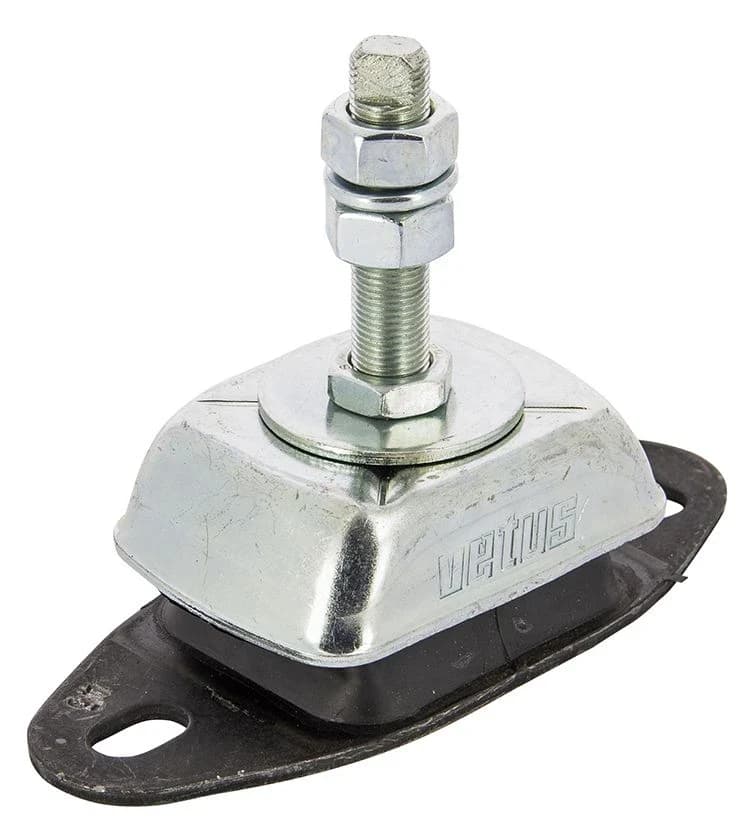
The classic adjustable mounts for small and mid-size auxiliaries — soft 45–65 Shore compounds, loads from 15 to 100 kg per mount. K25V/K35V/K40A suit 1–3 cylinder engines where vibration isolation matters most.
Hydro-damper (MITSTEUN)
Combines a rubber-metal damper with a hydraulic shock absorber and equal stiffness in every direction — for installations that need motion control as well as isolation.
HY-series
For diesels of roughly 30–125 kW, with or without a thrust bearing: low vertical stiffness for comfort, high fore-aft stiffness (1 : 1.2 : 3.5) so propeller thrust doesn't walk the engine.
LMX-series
The heavy hitters for roughly 70–350 kW — very high fore-and-aft stiffness (1 : 1 : 7), loads to 500 kg per mount, M20 studs.
Guides & resources
The selection maths, the alignment procedure, and the rattle nobody should ignore.
Mount & coupling selector
Load window maths for mounts, shaft-size lookup for Bullflex couplings.
OpenEngine alignment guide
The Vetus mount-adjustment sequence, the feeler-gauge rule, and why you re-check afloat.
OpenDamper drive plates
Why gearboxes rattle at idle, how plates fail, and what we need to identify yours.
OpenMounts & couplings FAQs
How do I work out which engine mounts I need?
Start with arithmetic: total weight of engine plus gearbox, divided by the number of mounts (normally four), gives the static load per mount. Pick a mount whose published minimum–maximum window brackets that figure — Vetus specifies both, because a mount that never compresses to its working range isolates nothing, and one that's overloaded bottoms out. Then check the family suits the job: high fore-aft stiffness (HY, LMX) where propeller thrust feeds through the mounts. Our selector does the sums.
Softer or harder mounts — which is better?
It's a trade-off, and it's why Vetus publishes Shore hardness for every mount. Softer rubber isolates vibration better but lets the engine move more; harder rubber controls movement but transmits more vibration. The range steps hardness with load — 45 Shore on the small K-series up to 65 Shore on the K100V and LMX500 — so matching the load window usually lands the hardness right too.
Why does my gearbox rattle at idle?
Classic damper plate symptom. Modern diesels run light flywheels, and at idle their firing pulses make the gearbox input gear chatter — the damper plate between flywheel and gearbox absorbs it. A metallic rattle at idle (often loudest in neutral) that vanishes as revs rise points straight at it; worn plates eventually shed springs into the bellhousing. To identify a replacement we need the spline count and shaft diameter, plus the backing plate's diameter, bolt count and PCD.
Do I need a flexible shaft coupling as well as flexible mounts?
They work as a system. Flexible mounts let the engine move; a rigid shaft connection then feeds that movement straight into the stern gear. A flexible coupling like the Bullflex absorbs the residual misalignment (up to 2 degrees) and torsional vibration — and sizes 1 through 32 carry thrust ratings from 2 to 20 kN, so the propeller can push the boat through the coupling. The exception is engines with separate thrust bearings; ask us if unsure.
Can you supply mounts for non-Vetus engines?
Yes. Mounts are selected by load, stud size and geometry, not engine brand — and alongside Vetus we stock Australian-made Poly Flex mounting systems, which span over 1,700 models from 2 kg to 2,000 kg per mount. Send the engine model and weight (or photos of the old mounts with their dimensions) and we'll match it.
When should engine alignment be checked?
Whenever mounts are replaced, the boat is repowered, or vibration appears — and always again once the boat is afloat: hulls settle in the water, so Vetus' manual requires re-verifying alignment after launch. The accepted workshop rule is a feeler-gauge gap at the coupling faces of no more than about a thousandth of an inch per inch of coupling diameter. Old, sagged mounts are the most common reason alignment won't hold.
Mounts, coupling and plate — quoted as a set
Send the engine and gearbox models (or the weights and shaft size) and we'll confirm the whole driveline package against the manufacturers' data.
Repowering? We supply matched mounts, couplings and drive plates for new engine packages too.
(03) 5973 6444