
Marine Exhaust Systems
A wet exhaust does three jobs at once — cools the gas, silences the engine and keeps the sea out. We supply the complete Vetus system: waterlocks and mufflers, goosenecks, gas/water separators, and exhaust hose by the metre from 30 to 305 mm.
Water in the exhaust — on purpose
After cooling the engine, the raw water is injected into the exhaust at the mixing elbow. Instantly the gas drops from hundreds of degrees to a temperature rubber hose can carry, the exhaust note turns to a soft burble, and gas and water travel together to the transom. It's why an inboard can run quiet flexible hose instead of hot steel pipe.
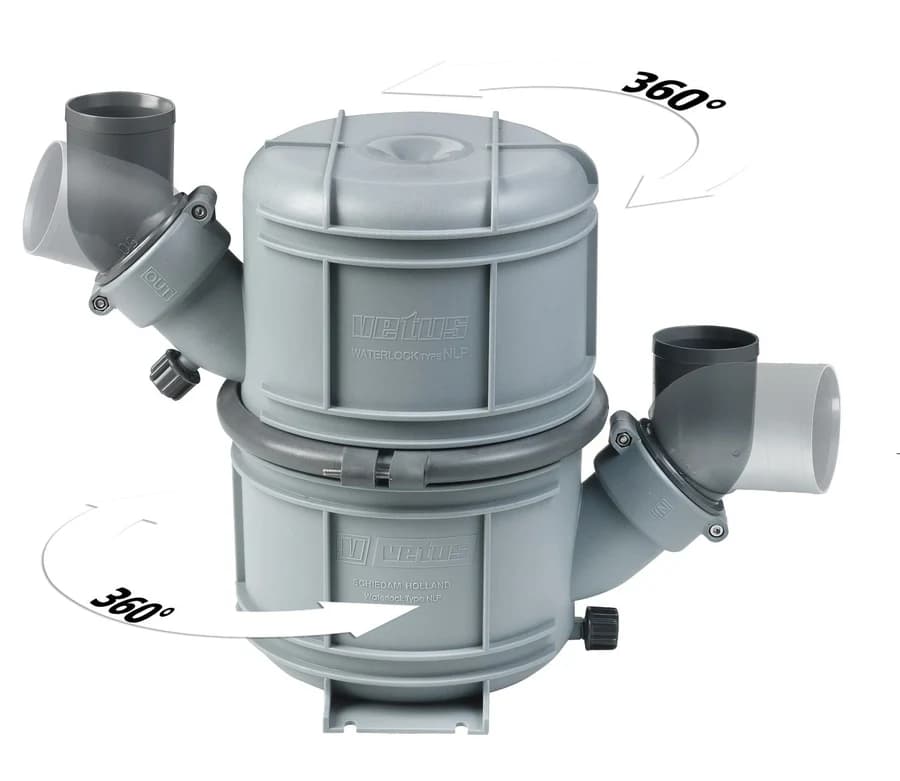
The catch is gravity: when the engine stops, the water still in the hose runs back downhill. The waterlock exists to catch every drop of it before it reaches the engine's exhaust valves — and the goosenecklifts the hose above the waterline so the sea can't push in from outside. Size those two right and a wet exhaust is near-silent and boring for decades.
The raw water side of the cooling system and the exhaust are one circuit — the full story is in how marine heat exchangers work.
The Vetus range
Waterlock families for every layout — plus goosenecks, gas/water separators (quieter sterns on fast boats), air vents for siphon protection, transom connections and EPDM exhaust hose by the metre, rated 100 °C continuous.
LP — the standard waterlock
The everyday plastic waterlock/muffler, 30–90 mm hoses; R-versions add a 360°-rotatable inlet so the hose meets it at any angle.
LSS / LSL — small & long-run
Compact LSS for tight spaces, both connections rotatable; extra-large-capacity LSL for long exhaust runs where more water drains back at shutdown.
LSG — with non-return valve
Adds a non-return valve that virtually prevents water backing up the system — insurance for awkward layouts and following seas.
NLP / NLP3 / NLPH — quiet ones
Dual-stage and three-chamber waterlock/mufflers (Vetus claims up to 10 dB quieter than a traditional waterlock); NLPH lies horizontal where vertical space is short.
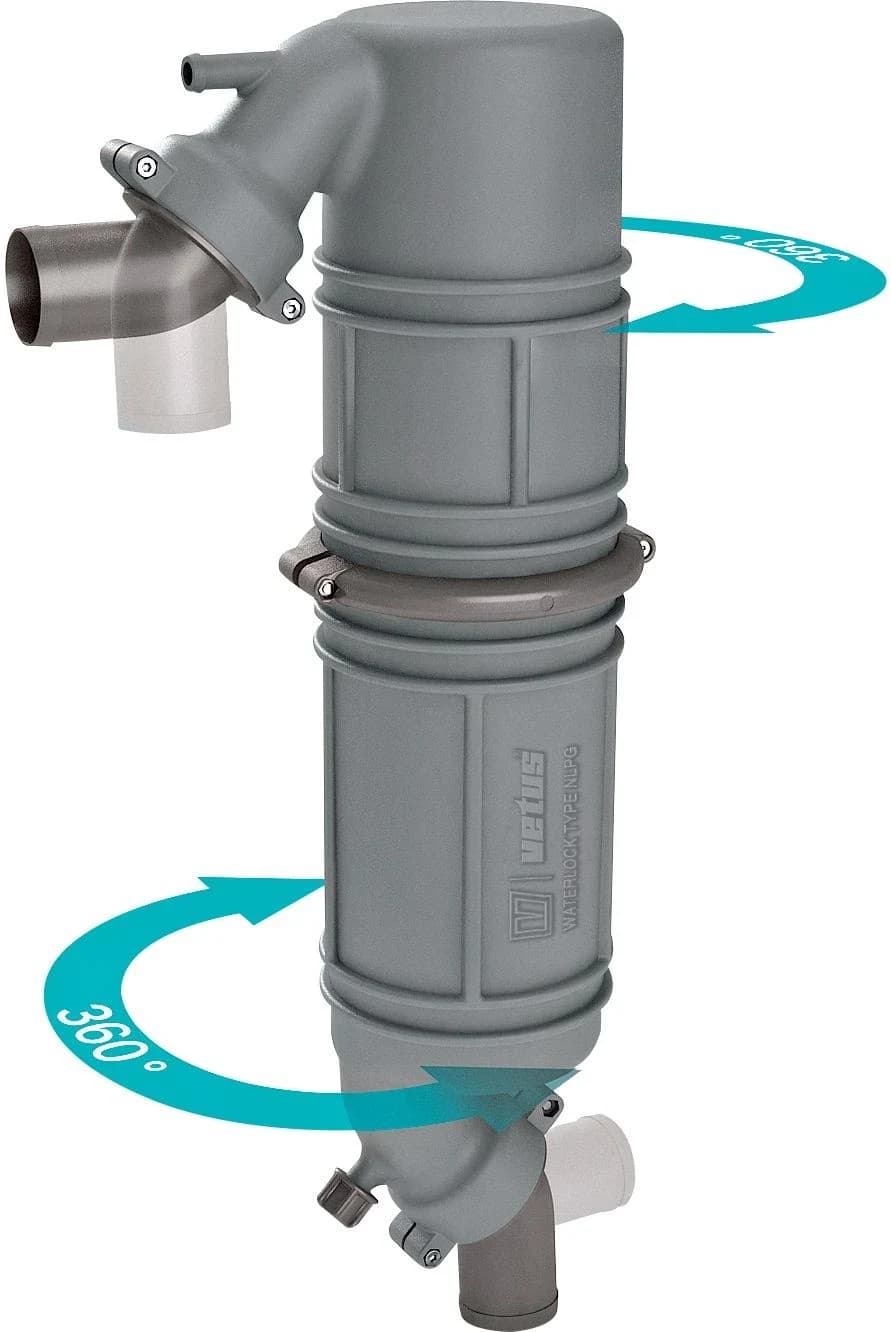
NLPG — waterlock + gooseneck in one
Combines muffler and gooseneck in a single moulding — saves installation space and parts.
NLP HD / HPW / MV / MGP — heavy & fast
NAVIDURIN heavy-duty units rated to 260 °C, high-performance waterlocks to ~300 hp, check-valve mufflers for fast craft, and MGP/MGS/MGL for larger vessels.
Guides & tools
The design rules straight from Vetus' installation manual, and the sizing maths done for you.
Exhaust FAQs
What size exhaust hose does my engine need?
Two constraints: never smaller than the engine's exhaust outlet, and big enough for the engine's power at its allowable back pressure. Vetus publishes the sizing at 0.1 bar — 40 mm hose to 18 kW, 60 mm to 39 kW, 90 mm to 89 kW and so on up to 152 mm at 254 kW. If your engine maker allows more back pressure, the same hardware covers more power. Our sizing tool runs the lookup.
How big should the waterlock be?
Big enough to swallow every drop that drains back down the hose when the engine stops — that's its whole job. Vetus' catalogue calculation assumes a quarter of the hose volume is standing water and doubles it for safety: about 1.4 litres of capacity per metre of 60 mm hose, for example. Sailing boats deserve extra capacity again, because they roll and pitch with the engine off — Vetus calls an extra-large waterlock 'of vital importance' there.
Where does the waterlock go?
Always lower than the engine's exhaust outlet, as vertical as possible, and strapped down properly — it gets heavy when full. Vetus also wants the waterlock's inlet below the injection bend, with at least 5 cm between the underside of the engine's cooling-water outlet and the highest point of the waterlock under all sailing conditions (heel included) — and the gooseneck mounted as directly above the waterlock as possible so less water drains back at shutdown.
Do I need a siphon break (air vent)?
If the water injection point is below — or less than 15 cm above — the waterline, including when heeled under sail: yes, without exception. Below that margin, raw water can siphon through the cooling circuit into a stopped engine. The fix is an air vent (vented loop) in the hose between engine and injection point, mounted at least 40 cm above the waterline.
Why does my boat have a gooseneck at the transom?
It's the wall that stops the sea walking up your exhaust. The gooseneck lifts the hose above the waterline so following seas and heel can't backfill the system — Vetus suggests a high point around 45 cm, but not over 150 cm, because every centimetre of lift adds back pressure the engine must push against. The transom outlet itself should sit at least 10 cm above the loaded waterline.
How long do wet exhaust components last?
The plastic waterlocks and hose are long-lived; the wear item is the mixing elbow where hot gas meets salt water — corrosion attacks it from both sides, and industry guidance generally puts inspection/replacement somewhere in the 3-to-7-year band depending on use. A rattling, flaking or weeping elbow, soot at the joins, or salt crusts are the tells. We can supply hose by the metre and every Vetus component.
One enquiry, the whole exhaust
Engine power, hose run, waterline heights — send what you know and we'll spec waterlock, gooseneck, hose by the metre, clamps and the siphon break if you need one.
Every selection checked against Vetus' installation rules before we quote.
(03) 5973 6444